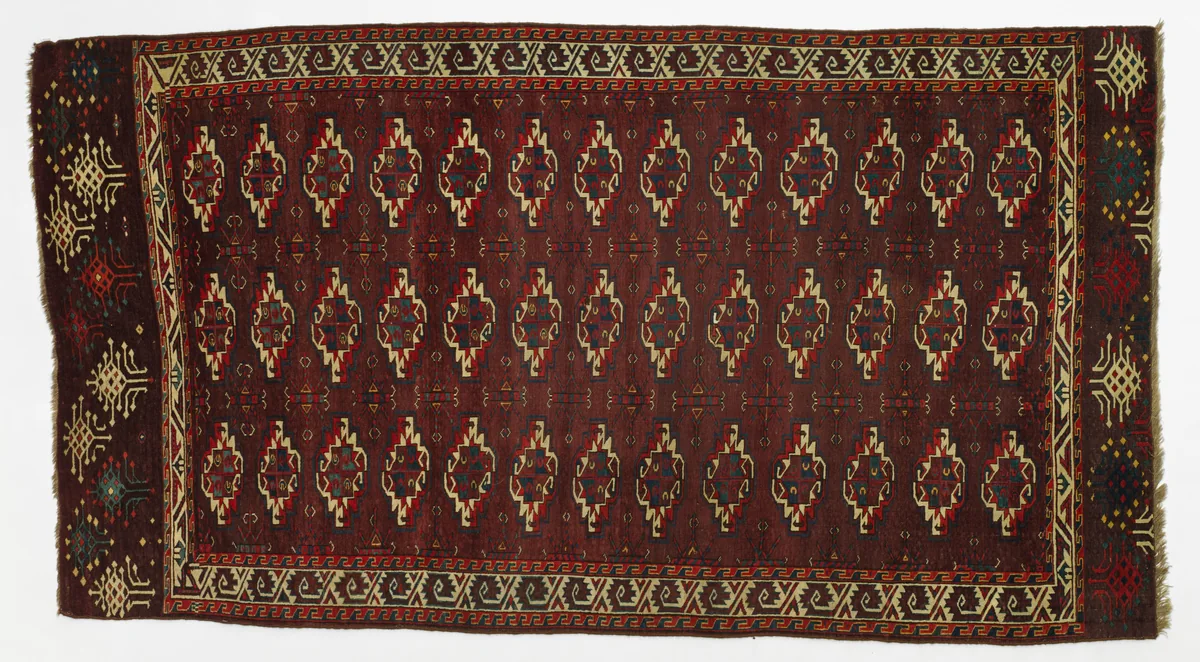
Learning to see the pattern
A patterned rug can seem almost overwhelming at first. Your eye moves between bright accents, dark outlines, and repeated medallions, sometimes without settling anywhere. Choose one shape and follow it for a moment. The design begins to reveal its organization.
These patterns belong to textiles made for particular lives and purposes. The Smithsonian’s Turkmen collection includes carpets, storage-bag faces, a door rug, and a tent band. Its account describes weavers adapting the size, shape, and color of motifs to different techniques and functions.1
Looking closely brings those choices into view. A large carpet offers room for an extended arrangement; a bag face concentrates the design into a smaller surface. Within either object, a border may follow a different rhythm from the central field.
This guide introduces a way of looking: first identify the main areas, then examine individual motifs, and finally consider the names and interpretations attached to them. You can begin with ordinary descriptions and develop a more specialized vocabulary as you go.
For the wider background, read our Beginner’s Guide to Turkmen Rugs. Our Rug Styles & Weaving Traditions guide explores the communities and catalogue attributions behind the objects.
A map of the rug: Field, borders, and ends
Before following an individual motif, find the larger areas of the composition.
Find the larger areas
- 1 Field
- The central patterned area inside the framing bands.
- 2 Border
- Follow the pale band along the long side.
- 3 End panels
- Decorated areas at the left and right in this photograph.
The field
The field is the main design area within the borders. It may contain repeated medallions, a network of smaller shapes, or a composition divided into separate parts.
Begin by describing the arrangement. Are the larger forms lined up, staggered, or connected? How much ground remains visible between them? This gives you a useful account of the design before you try to name it.
Borders and guard stripes
The main border is a prominent framing band around the field. Narrower bands, often called guard stripes, may separate it from neighboring areas.
Trace a border along one side and around a corner. Notice whether the forms continue in the same way or change direction and arrangement. Compare the long sides with the ends.
A Powerhouse flatweave, catalogued as Tekke, provides one documented example: its main border has a diamond repeat and is wider along the long sides than across the ends.2
End panels and fringe
Some carpets have distinct decorated end panels. Cleveland Museum of Art describes these areas as elem in its Yomud main carpet, object 2010.190. The record draws attention to their stylized floral decoration.3
Look separately at any decorated panel, plain woven extension, and loose fringe. These occupy different positions in the textile. In a pile rug, the foundation includes lengthwise warp threads and crosswise wefts; the pile is an additional element forming the patterned surface.4
A complete photograph helps you keep these parts in view. A close crop can make a detail easier to study while concealing where it belongs.
Understanding the gül
The repeated medallions commonly called güls are among the most familiar features of Turkmen carpets. You will encounter spellings including gul, gül, and göl in rug literature. The term is connected with the Persian word for flower, although the history and interpretation of these forms are more complex than that translation suggests.5
Continue with Bokhara Rugs: History, Patterns & Origins to see how repeating Turkmen medallions became familiar in later commercial designs.
Look inside the outline
A gül deserves attention at several scales. Begin with its outer boundary, then follow its internal divisions, colors, and smaller forms.
The Met’s Yomut Main Carpet, object 1974.149.44, is a useful example. Its staggered medallions have serrated octagonal outlines, smaller octagons inside, and central floral devices. The record dates the carpet to probably the late eighteenth century and attributes it to western Turkmenistan.6
Use the example to separate three observations: the overall outline, the design inside it, and the way the motif repeats across the field. Each tells you something different about the composition.
 View the textile
 Enlarge detail
Larger motifs and smaller companions
Look between the principal forms as well as inside them. Smaller devices can establish another pattern across the same ground.
The Met’s educational study of Arabatchi-attributed storage-bag faces describes quartered medallions arranged within a grid of small octagons with green extensions.7 Its individual collection record identifies one surviving face as part of a deep storage bag, or chuval.8
This is a useful change of format. Ask how the motif arrangement fits the bag’s rectangular face, and how that arrangement compares with a complete floor carpet. Keep the scale and function of the object alongside the pattern in your notes.
 View the textile
A small motif gallery
Names help you find related examples. Begin with the form described in a particular collection record, then look at how the maker used it.
Hooked forms and ram’s horns
Saint Louis Art Museum identifies a stylized ram’s-horn pattern in white along the outer border of its Door Cover (ensi), object 185:1984.9
Try tracing a single hooked unit. Look for a partner facing the other way, then follow the next pair. Describe the arrangement as well as the name: hooked forms may be paired, repeated, or interlocked in the example you are studying.
 Enlarge detail
Diamonds and lattice arrangements
A diamond is an individual shape; a lattice is an arrangement that can organize a larger surface. Notice whether diagonal lines connect the shapes or whether separate motifs create the impression of a network.
Powerhouse’s Tekke-attributed flatweave, object 85/1900, includes quartered diamond forms among interlocking hooked motifs.2 Compare an individual diamond with the surrounding repeat. Does it remain visually separate, or become part of a larger pattern when you step back?
Rosettes and stylized floral forms
A flower-like device can be highly geometric. Examine its center, the forms radiating around it, and the way its outline changes at the edges.
Powerhouse describes rosettes around two blue ertman güls on a Chodor storage bag, object 2015/26/119.10 Cleveland’s Yomud carpet offers another setting for floral decoration in its end panels.3
These examples encourage you to look beyond the central field. A small surrounding device or an end-panel pattern may deserve as much attention as a large medallion.
 Enlarge detail
Named gül examples
Powerhouse uses ertman for the principal güls of its Chodor bag and dyrnak for those in a Yomut main carpet, object 2015/26/4.1011
Keep a name attached to its source and example. When comparing another textile, examine the outline, internal divisions, surrounding motifs, and arrangement together. A shared catalogue term gives you a starting point for comparison.
Meanders and framing devices
A meander follows a winding or turning course. In a border, a connecting line can carry the eye from one repeated element to the next.
Powerhouse’s Yomut main carpet has boat-shaped forms along a narrow geometric vine in its long borders, with elongated diamonds described in the shorter borders.11 Follow the framing around the complete object and notice how the designs relate across its different sides.
How patterns work together
A motif is one part of a larger arrangement. Once you recognize a repeated form, look at the relationships that hold the composition together.
Repetition and rhythm
Choose one unit and follow its next appearance. Continue across several rows or along a border. Pay attention to direction and spacing, including the ground between the motifs.
The same shape can contribute to different visual effects depending on its surroundings. Closely packed forms may seem to merge into a continuous surface; more widely spaced forms invite you to see them individually. Try describing that effect before concentrating on fine internal details.
| Feature | What to look for |
|---|---|
| Repeat | A shape or group of shapes appearing again. |
| Alternation | A change that recurs between neighboring units or rows. |
| Reflection | Forms facing one another as mirror images. |
| Rotation | A related form turned around a point. |
| Spacing | The intervals between motifs and their relationship to the ground. |
These are looking tools. Use the terms that describe the selected textile, and leave room for variation within its design.
Color and contrast
Follow a light accent through several repeated motifs. Then choose a darker area and do the same. You may discover a second rhythm that was less obvious when you concentrated on outlines.
Powerhouse’s Yomut record specifically notes how white appears on opposite sides of the dyrnak güls in alternate rows.11 That observation connects color to the arrangement of the repeat.
In your own description, record where a color appears and what it emphasizes. Consult the collection record for information about fibers and dyes. The visual effect and the material explanation are related questions that can be examined separately.
From detail back to the whole
Return regularly to a complete view. Ask how the borders frame the field, how the ends affect its balance, and whether a small motif links several areas.
The Smithsonian’s account emphasizes that weavers adapted their motifs to different textile techniques and uses.1 Studying the complete object helps you appreciate those choices alongside the attraction of a single detail.
What do the motifs mean?
Patterns can carry cultural associations, express belonging, and invite interpretation. A useful explanation makes clear what kind of evidence supports each claim.
What can we see?
Begin with a description that another viewer can check: a hooked outline, four divisions, repeated blue forms, or a border alternating between light and dark devices.
Getty’s guidance on describing artworks includes their visible design elements and pattern names as part of a physical description.12 This provides a sound foundation for further discussion.
What does the source call it?
A conventional name helps connect an object with comparable examples and specialist literature. It may describe an appearance or identify an established category.
Record the museum’s wording and the object number. If another author uses a different spelling or term, compare their actual examples. Technical vocabulary in carpet studies has not always been standardized.4
What interpretation is offered?
An interpretation takes the discussion further. Powerhouse explains small triangular motifs on its Tekke-attributed flatweave as protective devices associated with safeguarding the household.2
Saint Louis Art Museum describes four rectangles of repeated blue trees on its door cover and suggests that they may represent four gardens.9 That qualification belongs with the interpretation.
These accounts give readers meaningful cultural context. Keep the explanation connected to the particular work and source, and preserve the distinction between a visible feature, its name, and a proposed reading.
 View the textile
 Enlarge detail
| Kind of statement | Example of its role |
|---|---|
| Observation | Describes a shape, color, position, or arrangement that can be examined. |
| Terminology | Gives the name used by a museum, maker, community, or researcher. |
| Interpretation | Explains a possible association or meaning and identifies its evidence. |
Shared designs and attribution
Designs also travelled between weaving traditions. Cleveland’s Saryk-attributed carpet, object 2006.201, incorporates a principal gül associated with Salor weaving. Its record discusses shared smaller motifs and borders, alongside other evidence relevant to the attribution.13
A recognizable shape can open an investigation. Materials, structure, color, and the wider composition help develop it. Denny’s survey of Central Asian carpets discusses design exchange and the importance of this broader evidence.5
A guided looking exercise
Open The Met’s Tekke Main Carpet, object 22.100.45. The museum dates it to the early nineteenth century and attributes it to Turkmenistan.14
Work through six observations:
 View the textile
 Enlarge detail
- Find the field. Describe its shape and its relationship to the surrounding borders.
- Follow one larger motif. Trace its outline, then find its next appearance.
- Look between the motifs. Choose a smaller form and follow its arrangement.
- Trace a color. Note where it appears within several repeated units.
- Move toward an edge. Compare a border with the field and examine an end.
- Read the record. Add the museum’s materials, date, and attribution to your own observations.
Keep two short sets of notes: what you observed and what the record states. You can then return to the photograph and identify which details support your description.
For a second exercise, apply the same questions to The Met’s Storage Bag (Chuval) Face, 22.100.40a. Consider how the change of format affects your experience of the pattern.8
Frequently asked questions
What is a gül?
In this guide, the term refers to a repeated medallion associated with Turkmen weaving. Study its outline, internal design, and position in the larger composition. Collection records use the term for forms that need to be compared in their particular context.
Does every motif have one fixed meaning?
An explanation needs evidence for the motif, object, and context being discussed. Some museum records offer a cultural interpretation; others concentrate on description. Retain words such as “may” when they express the source’s level of certainty.
Can a pattern identify a rug’s weaving tradition or age?
A pattern can suggest useful comparisons. Attribution and dating involve a wider assessment of the textile and its supporting records. A shared shape alone cannot establish an individual carpet’s history.5
Why do motif names and spellings differ?
Different publications may use different terminology or spellings. Start with the object number and collection link, then compare the illustrations and definitions being used. A familiar-looking name is most useful when you can connect it to a specific example.
Why can similar motifs look different on two textiles?
Compare their scale, internal details, colors, spacing, and function within the composition. Consider the type of textile as well. The relationship becomes clearer when you study each complete object alongside its individual motifs.
Sources and further reading
The descriptions above refer to individual objects and the cited publications. Follow each collection link for photographs, current catalogue information, and credits.
-
Smithsonian, National Museum of Asian Art, Turkmen textiles. ↩↩
-
Powerhouse, Tekke Turkmen main carpet, late 1800s, 85/1900. Purchased 1985. ↩↩↩
-
Cleveland Museum of Art, Turkmen Main Carpet, 2010.190. Mid-1850s, Yomud attribution; Gift of E.B. and Joan C. Long. ↩↩
-
Annette Ittig, “Carpets iii. Knotted-pile Carpets: Techniques and Structures,” Encyclopaedia Iranica. ↩↩
-
Walter B. Denny, “Carpets xvi. Central Asian Carpets,” Encyclopaedia Iranica. ↩↩↩
-
The Metropolitan Museum of Art, Yomut Main Carpet, 1974.149.44. Bequest of Joseph V. McMullan, 1973. ↩
-
The Metropolitan Museum of Art, Image 39: Storage bag faces. Educational study of 22.100.40a,b. ↩
-
The Metropolitan Museum of Art, Storage Bag (Chuval) Face, 22.100.40a. The James F. Ballard Collection, Gift of James F. Ballard, 1922. ↩↩
-
Saint Louis Art Museum, Door Cover (ensi), 185:1984. Gift of Mr. and Mrs. Irvin Dagen. ↩↩
-
Powerhouse, Storage bag (mafrash), Chodor Turkmen, 2015/26/119. Donated through the Australian Government’s Cultural Gifts Program by Robert Upfold, 2013. ↩↩
-
Powerhouse, Main carpet (khali), Yomut Turkmen, 2015/26/4. Donated through the Australian Government’s Cultural Gifts Program by Robert Upfold, 2013. ↩↩↩
-
Getty, Categories for the Description of Works of Art: Physical Description, section 13.1. ↩
-
Cleveland Museum of Art, Turkmen Main Carpet, 2006.201. Saryk attribution; Gift of Arlene C. Cooper. ↩
-
The Metropolitan Museum of Art, Tekke Main Carpet, 22.100.45. The James F. Ballard Collection, Gift of James F. Ballard, 1922. ↩