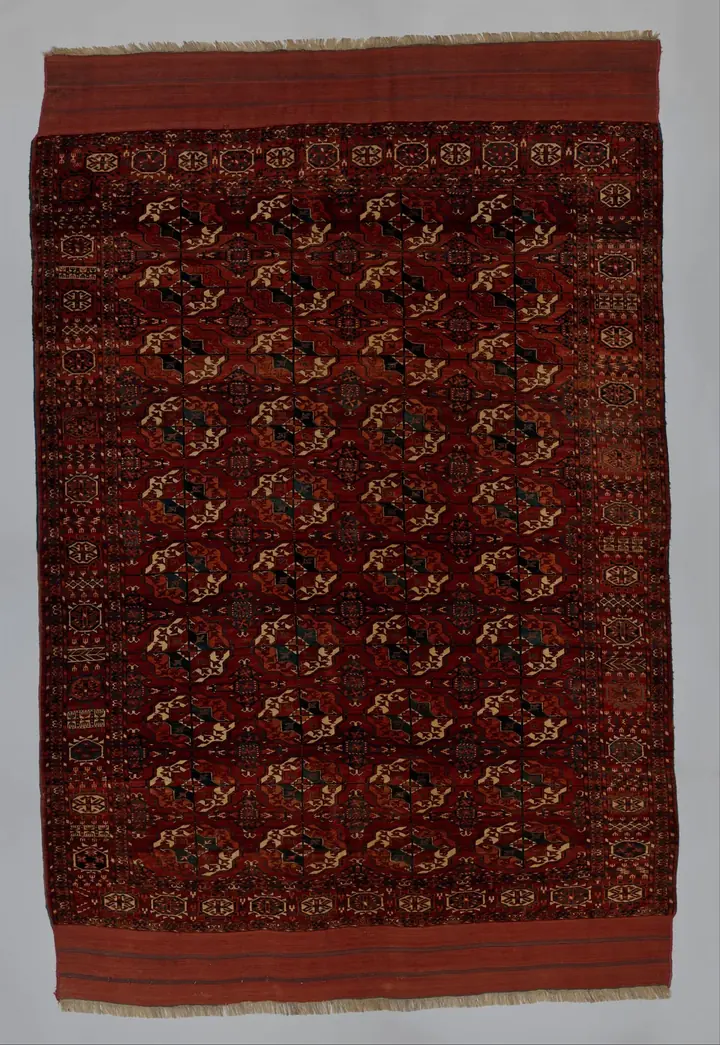
Start with the rug you have
Before choosing a cleaning method or hanging system, gather what you know about the piece. Look at its purchase record, any condition report, and notes about previous cleaning or repairs.
Find out what the surface and foundation are made from. The visible pile and the underlying structure may contain different fibres; a description that simply says “wool” may leave important questions unanswered. Our beginner’s guide explains the main construction terms.
Examine the rug in good light, supporting it as you look. Notice loose ends, splits, weakened edges, areas of loss, repairs, and any signs of insects or dampness. Do not pull threads or flex a brittle area to test its strength.
Use that information to choose your starting point:
| What you observe | A sensible next step |
|---|---|
| A rug that appears sound and is already in everyday use | Review its placement and establish appropriate routine care. |
| An older piece with uncertain materials, repairs, or treatment history | Request advice before washing, stain treatment, or changing its display. |
| Fragile fibres, loose structural elements, or active deterioration | Limit handling and arrange a textile conservation assessment. |
The table helps organize decisions; it cannot establish that a particular treatment is safe. Keep dated photographs of the front, reverse, edges, and existing damage. A small condition record gives you something to compare with when you notice a change.
The face and the reverse
 View photographFront detail
 View photographReverse detail
Everyday care for a rug used on the floor
Placement, furniture, and underlay
Choose a position that suits the rug’s condition and the amount of wear it will receive. Pay attention to chair movement, concentrated traffic, and furniture pressing on the same area. Lift furniture when repositioning it, and consider suitable furniture cups to spread pressure.
A compatible underlay can cushion the rug and help it lie evenly. Choose it for both the textile and the floor beneath. Conservation guidance cautions against adhesive-backed and potentially damaging underlays; periodically check for crumbling, sticking, staining, or other deterioration. Replace a pad that is causing problems rather than leaving it hidden beneath the rug.2
The label “non-slip” does not answer every compatibility question. For an important older rug, ask a specialist about the proposed underlay before buying it.
Vacuuming with care
For a rug suitable for surface cleaning, use low suction and a controllable, non-powered attachment. Avoid beater bars and rotating power heads. Work gently with the direction of the pile, protecting fringes and weakened areas from being caught.
A protective screen can be useful in appropriate circumstances, but it does not make a very fragile rug safe to vacuum. Broken threads, powdering fibres, or loose elements may rule out cleaning until a conservator has assessed them. Suction should remove loose dirt without lifting or dragging the textile.3
When its condition and safe handling allow, attend to the reverse, underlay, and floor beneath as well. These areas can otherwise escape notice during ordinary housekeeping.2
Set the cleaning schedule according to use, dust, and condition. A frequently used floor rug and a protected display textile have different needs. Inspection should guide the work; repeated cleaning without a reason can introduce avoidable wear.3
Spills, stains, and professional cleaning
Why a spot test is not enough
Water can affect more than the visible red field. Foundation yarns, repair threads, backing fabrics, and different colours may respond differently. A cleaning assessment must consider the whole construction.
The Canadian Conservation Institute explains that colourfastness testing can itself damage a test area and cannot guarantee what will happen during washing or drying. Passing a small test therefore does not establish that an antique rug can safely be soaked or washed. A description such as “natural dyes” should not replace that assessment.5
Choosing professional help
For a sound rug in everyday use, look for someone with relevant experience cleaning handwoven textiles. For a fragile, historically important, or uncertain piece, begin with a textile conservator.
Useful questions include:
- What does the condition assessment show?
- How will existing repairs and the foundation influence the proposed method?
- What risks remain, and what result is realistic?
- How will the rug be supported and dried?
- Will treatment and any changes be documented?
Cleaning does not automatically mean removing every mark. Agree on the purpose of the work before treatment begins: routine maintenance, dealing with a particular incident, or stabilizing a vulnerable textile.
Protecting colour and fibres in the home
Manage light exposure
Both daylight and artificial light can affect textiles. Damage depends on intensity and duration, and it accumulates over time. Fading is not reversed by moving the rug to a different position.
Choose a location away from direct sun where possible. Use window coverings, and consider how long display lighting remains on. UV-filtering materials can reduce one part of the exposure, but visible light still matters. For a sensitive collection piece, periods off display may form part of a conservation plan.6
Turning a floor rug can help distribute wear, provided it can be moved safely.2 That is a separate benefit from reducing its total light exposure. If sunlight reaches the room every afternoon, addressing the window or choosing a different position is more effective than relying on rotation alone.
Notice the conditions around the rug
Consider radiators, fireplaces, heating outlets, cold exterior walls, and sources of dampness. The conditions at the rug may differ from those elsewhere in the room.
The Textile Museum emphasizes environmental stability and careful control of light, heat, and moisture. Its collection-care guidance provides museum-oriented targets, but an individual rug’s needs should inform how those principles are applied at home.7
A temperature and humidity monitor can help replace guesswork with observations. Pay particular attention to seasonal changes, condensation, and leaks. Persistent dampness deserves action even if the rug’s surface still looks attractive.
Suspected mould requires a different response from ordinary dust. Seek conservation advice before disturbing or cleaning an affected piece, and address the environmental cause so it does not recur.8
Moths, carpet beetles, and regular inspection
Include sheltered parts of the rug in your checks: the reverse, edges, areas under furniture, and places hidden by a lining or mount. Inspect stored pieces too.
Possible signs of insect activity include larvae, cast skins, webbing, cocoons, granular deposits, and new areas of fibre loss. Finding an insect or an old hole does not, on its own, establish the extent or activity of an infestation. Identification and monitoring help determine the next step.9
Check newly acquired textiles before placing them among other rugs. If you suspect an insect problem, keep the affected piece separate and obtain advice about suitable containment and treatment. Conservation guidance uses isolation, inspection, housekeeping, and continuing monitoring together; no single measure replaces the others.12
Clean the surrounding area, including spaces normally concealed by furniture. A rug left undisturbed for a long period can be easy to overlook, whether it is rolled in storage or hanging on a wall.7
Monitoring traps can help locate or identify activity. They should not be treated as proof that insects within the textile have been eliminated.9
Avoid selecting a treatment simply because it worked on another household item. Temperature treatments require a suitable process, and unusual materials or a weak condition may change the plan. For a valuable or fragile rug, discuss the approach with a conservator before attempting treatment.7
Displaying a Turkmen rug on the wall
Wall display allows a design to be appreciated at eye level. It also changes how the textile’s weight is supported. Before choosing hardware, consider its dimensions, weight, construction, and ability to bear that load.11
Distribute the support
For suitable textiles, conservators use a prepared hook-and-loop system to distribute support across the hanging width. The loop tape is attached to an intervening fabric band or sleeve, which is appropriately sewn to the textile. The corresponding hook tape is secured to a support on the wall.
This is a prepared mounting system, not adhesive tape applied directly to the rug. Nails, staples, or isolated rings through the textile can create concentrated stresses and damage. The mounting should be designed and installed for the individual piece.10
A continuous strip is not sufficient justification for hanging every rug. A textile too weak to support its own weight needs another approach.
Consider supported mounting or framing
A conservator may recommend a supportive panel or another mount that carries more of the textile’s weight. Small fragments and delicate pieces can have quite different requirements from a sound, complete rug.
When framing is appropriate, the mount, backing materials, and glazing need to work together. Glazing should be separated from the textile by suitable spacing. Acrylic has advantages in some situations, but its static properties can also matter around loose fibres; the choice deserves more than a decision about appearance.11
Plan the location at the same time as the mount. Leave a practical way to inspect the reverse and surroundings, control light, and remove the piece when necessary. Display arrangements should make future care manageable.
Handling, rolling, and storing a rug
Plan the move first
Prepare the route, destination, and support before lifting. Use enough assistance for the rug’s size and weight. Wash your hands, remove anything that may snag, and handle the support rather than allowing a weak textile to take the strain.
Conservation guidance recommends planned movements and appropriate supports for oversized textiles. A tube or custom support can help with handling, but the method must suit the piece. Avoid dragging a rug by its fringe or asking one corner to carry the weight.12
Before storage, arrange appropriate cleaning if needed and check for insect or mould problems. A damp rug needs prompt advice about drying and support before it is packed away.148
Use a supported roll when appropriate
For pile rugs suitable for rolling, CCI recommends a sufficiently broad support tube and rolling with the direction of the pile, with the pile facing outward. The tube should extend beyond the textile, and the roll should be prepared smoothly without sharp folds.
Use suitable protective interleaving, such as prewashed cotton sheeting or unbuffered, neutral-pH tissue. For wool or silk, “acid-free” alone does not establish that a tissue is appropriate: alkaline buffering is an additional consideration. Protect the outside with a clean cover and secure it loosely. Arrange storage to support the core, rather than compressing the textile beneath its own weight or other objects.13
Recognize when rolling is unsuitable
A very weak textile, one with unstable layers, or a piece that cannot flex safely may need flat storage. Properly planned flat storage supports the whole object and minimizes folds and pressure. Choose compatible enclosure and lining materials, and avoid piling heavy items on top.14
Store the rug where conditions can be checked and the piece can be retrieved safely. Avoid positions exposed to leaks, persistent dampness, or excessive heat. A storage location that is convenient only because nobody visits it may also allow a developing problem to escape attention.
Label the wrapping or storage support rather than writing on the textile. Keep photographs and identifying information accessible so you do not need to unroll a piece merely to remember which rug it is.
Support the core of the roll
- Supported endsThe support carries the core beyond the textile.
- Protective coverA suitable cover shields the prepared roll from dust.
- Prepared rollCore, interleaving, and orientation are selected for the piece.
A simple care plan and when to get help
Build a short routine around observation and the rug’s actual use. You do not need a complicated system: a few dated photographs and a consistent set of checks are a useful beginning.
| Occasion | What to check | What to record or arrange |
|---|---|---|
| During ordinary room care | Traffic, furniture pressure, dust, and the rug’s position | Any change in wear or placement. |
| At a planned inspection, including stored pieces | Edges, reverse, repairs, and possible insect activity | Photographs of new or uncertain findings. |
| When seasons or room conditions change | Sunlight, heating, condensation, and dampness | Changes that affect the display or storage location. |
| Before moving or storing | Condition, supports, wrapping, and destination | A handling plan and enough assistance. |
| After a spill or other incident | The affected area and what happened | Time, substance, photographs, and professional advice. |
Seek help promptly when you notice structural change, unexplained fibre loss, colour movement, suspected pests or mould, or significant wetting. Do not keep treating the same symptom while its cause remains uncertain.
A textile conservator can examine the materials and construction, document condition, and discuss treatment options in relation to your aims.1 Explain how you hope to use the rug—on the floor, on a wall, or in occasional display—and ask what ongoing care the proposed treatment will require.
Keep assessment reports, treatment records, and updated photographs together. They help the next person understand what has changed and make your own future decisions easier.
Frequently asked questions
Can I vacuum a Turkmen rug?
If its condition permits, careful low-suction vacuuming can remove loose dirt. Fragile fibres, broken threads, or loose structural elements require assessment first. Protect vulnerable areas and avoid powered rotating heads.3
Can I wash one at home or use a carpet-cleaning machine?
Do not assume household carpet equipment is suitable for a handwoven rug. For an antique or uncertain piece, seek advice before wet treatment. Washing suitability depends on the whole textile; a small colourfastness test is not a guarantee.45
How often should professional cleaning be considered?
Base the decision on condition, use, and soiling. Ask a specialist to explain what cleaning would achieve and whether its benefits justify the intervention. An automatic calendar cannot account for the differences between individual rugs.
How can I reduce the risk of moth damage?
Keep the surrounding area clean, inspect sheltered surfaces and stored textiles, and check incoming pieces. Investigate possible activity promptly. Monitoring helps reveal a problem, but treatment requires a plan appropriate to the rug.9
Sources and further reading
The guidance above draws on museum and professional conservation resources. Sources were consulted November 8, 2026; their original publication and revision dates vary.
-
American Institute for Conservation, Caring for Your Treasures: Textiles, available through its collection-care resources.
↩1↩2 -
Canadian Conservation Institute, Basic care — Carpets and rugs.
↩1↩2↩3 -
Canadian Conservation Institute, Mechanical Surface Cleaning of Textiles, Note 13/16.
↩1↩2↩3 -
Icon, the Institute of Conservation, Carpets and Rugs.
↩1↩2 -
Canadian Conservation Institute, Testing for Colourfastness, Note 13/14.
↩1↩2↩3 -
Canadian Conservation Institute, Textiles and the Environment, Note 13/1.
↩ -
The George Washington University Museum and The Textile Museum, Caring for Textiles.
↩1↩2↩3 -
Canadian Conservation Institute, Mould Growth on Textiles, Note 13/15.
↩1↩2 -
Canadian Conservation Institute, Preventing Infestations: Control Strategies and Detection Methods, Note 3/1.
↩1↩2↩3 -
Canadian Conservation Institute, Velcro Support System for Textiles, Note 13/4.
↩1↩2 -
The George Washington University Museum and The Textile Museum, Displaying Textiles.
↩1↩2↩3 -
Canadian Conservation Institute, Caring for textiles and costumes — Preventive conservation guidelines for collections.
↩1↩2 -
Canadian Conservation Institute, Rolled Storage for Textiles, Note 13/3.
↩1↩2 -
Canadian Conservation Institute, Flat Storage for Textiles, Note 13/2.
↩1↩2↩3
Photograph & illustration credits
The complete carpet, front detail, and reverse detail show Tekke Main Carpet, early 19th century, attributed to Turkmenistan, Central Asia. The Metropolitan Museum of Art; The James F. Ballard Collection, Gift of James F. Ballard, 1922; 22.100.45. Public Domain. Museum record ↗.
Responsive photographs are prepared from the museum images. The storage illustration is an original schematic based on the support principles in CCI Note 13/3. Site image credits.