A heritage woven into everyday life
The history of Turkmen weaving is closely connected with the history of the household. Woven textiles furnished floors and entrances, held belongings, and accompanied important occasions. Looking at their uses helps us understand the decisions behind their materials, shapes, and decoration.34
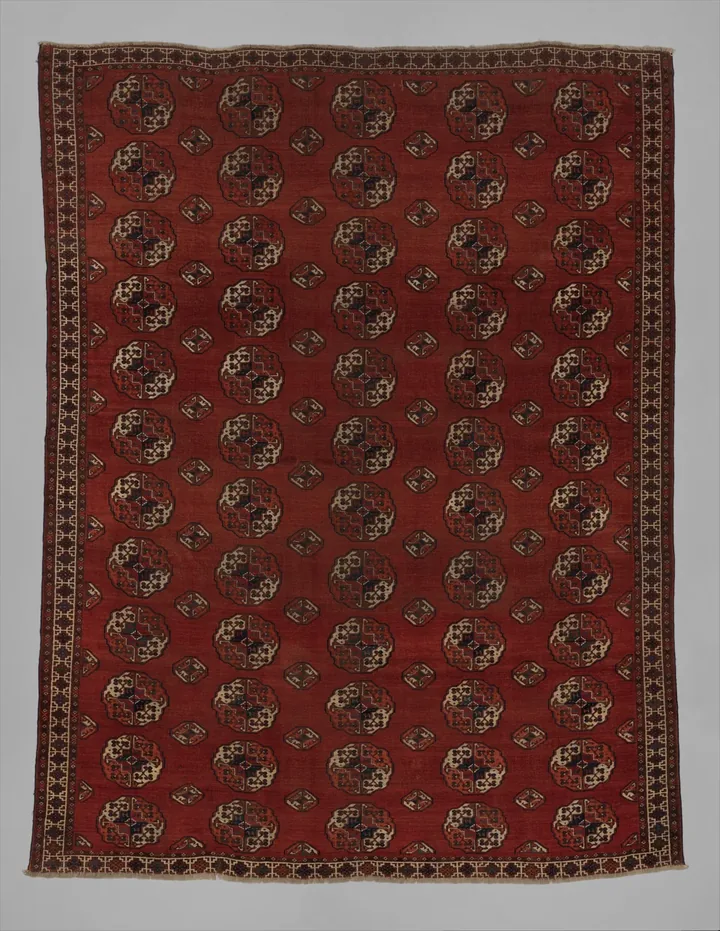
An individual object offers a useful place to begin. The Salor main carpet illustrated here is dated by The Metropolitan Museum of Art to the late eighteenth or early nineteenth century. Its record connects a surviving textile with a particular period and an attributed place of production.14
Early Central Asian carpet history is difficult to establish from securely dated objects, as carpet historian Walter Denny explains. The date of a surviving carpet cannot establish when an entire tradition began.7
Throughout this guide, museum records and historical accounts sit alongside documentation of continuing practice. Together they encourage us to ask three questions: who made the textile, what role did it serve, and what can its surviving record tell us?
People and places
Turkmen weaving belongs to a wider Central Asian setting. The Met describes historical Turkmen communities across a region now divided between Turkmenistan, Uzbekistan, Kazakhstan, and northeastern Iran. The Smithsonian's discussion of nineteenth-century textiles also places the subject within connections extending toward Afghanistan.65
Modern country names help us find the region on a map. Historical community names and museum attributions describe other aspects of the subject. A record may identify a textile with a weaving group, suggest a geographical area, and retain uncertainty about its precise origin. Those descriptions should be read together.
Movement, grazing, and settlement
Pastoral nomadism is a way of life organized around livestock and access to grazing. In the historical setting described by The Met, seasonal movement allowed herders to reach pasture and water. Possessions needed to be transported and the dwelling assembled again at the next stopping place.2
This gives portability a practical importance in the textile story. A furnishing could be packed, carried, and put to use in another location. Its construction and format belonged to that setting as well as to the skill of its maker.
Descriptions of this historical life need their period kept in view. The Met's educational account concerns eighteenth- to twentieth-century Turkmen art and society, and acknowledges subsequent settlement. It should not be read as a description of every Turkmen household today.1
Names such as Tekke, Yomut, Salor, Saryk, and Ersari appear throughout rug literature. Our rug styles guide introduces the weaving traditions associated with these names.
A regional orientation
- Turkmenistan
- Kazakhstan
- Uzbekistan
- Iran
- Afghanistan
The furnished home
A portable home could contain an extensive textile interior. The Met describes a domed wooden framework covered with felt, with carpets and bags furnishing the space inside. A main carpet could cover much of the floor; other coverings and containers served different household needs.3
Reading these objects by function makes their variety easier to understand:
| Textile form | Role in the historical home | A documented example |
|---|---|---|
| Main carpet | A substantial floor furnishing | The Met's Salor main carpet, dated late eighteenth–early nineteenth century.14 |
| Door hanging, or ensi | A textile associated with covering the entrance | The Met describes its first-half nineteenth-century example as likely used at a tent entrance.15 |
| Storage bag, or chuval | A container for household belongings | A surviving early nineteenth-century bag face in The Met's collection.16 |
| Tent band | Part of the wider group of furnishings used with a portable dwelling | A tent band is among the nineteenth-century textiles discussed by the Smithsonian.5 |
 View photograph
 View photograph
Recognizing part of a larger object
The decorated front of a bag can look like a small rug when displayed on its own. The Met's Storage Bag (Chuval) Face, attributed to Arabatchi Turkmen weaving, once formed the front of a deep container suspended within the tent. The surviving face represents part of that object.16
The door hanging offers another useful comparison. The Met's record retains the word “likely” when describing the illustrated textile's original entrance function. Keeping that qualification preserves the distinction between the surviving object and the museum's interpretation of its use.15
Together, these furnishings show why format matters. A textile's size, edges, shape, and surviving attachments can help us ask what it was made to do. A full photograph and a collection record often reveal more than an isolated view of a repeating motif.
The weavers: family knowledge and important occasions
Historical accounts give women a central place in Turkmen weaving. The Met describes young women learning from mothers and older sisters, developing the experience needed to make furnishings for household and ceremonial use. Its account also associates woven work with dowries and wedding decoration.4
One example is the asmalyk, a furnishing associated with decorating the camel carrying a bride between family homes. Understanding that setting helps explain why some woven objects take forms that differ from familiar rectangular floor carpets.4
Skill develops through repeated decisions: preparing materials, controlling tension, following or adapting a design, and finishing a piece for its intended use. Our craftsmanship page introduces the relationship between materials and woven structure.
Shared designs and community identity
Repeated motifs give many Turkmen weavings a recognizable visual character. The Smithsonian describes weavers adapting the size, shape, and colors of motifs to different techniques and functions, with particular designs becoming associated with community identity.5
These associations developed through use and variation. A Textile Museum program discussing later research describes revised weaving-group attributions and the role of photographic and scientific evidence in continuing study.9
A design can therefore begin an investigation. Looking at a repeated medallion may suggest a comparison with a documented weaving, while the reverse, foundation, sides, and ends offer further information. The museum's attribution remains part of that comparison, with any uncertainty retained.
For a beginner, it is useful to distinguish recognizing a resemblance from identifying a particular object. Two textiles may share a design vocabulary while differing in construction, place of manufacture, or production setting. A familiar pattern alone cannot supply the missing history.
Our patterns and motifs guide offers a closer view of fields, borders, and repeated forms. Here, those details sit within the broader story of shared knowledge and changing practice.
A changing world: settlement, trade, and production
Turkmen weaving continued through changes in livelihoods, markets, and political circumstances. The Met describes increasing settlement during the nineteenth century in response to the loss of pasture. Such changes altered the conditions in which people lived and worked.6
The pace and experience of change varied. It is more useful to follow a documented community or object than to imagine one moment when every household changed its way of life.
Household work and wider markets
Domestic production and commercial exchange existed alongside one another. A textile could meet a household need, contribute income through sale, and eventually pass through dealers or collectors. Its movement into another setting adds to the record we need to understand it.5
Denny places the growth of collecting and study within the context of Russian expansion in Central Asia. That history helps explain why military figures, travelers, and later collectors appear in the records and literature through which many older textiles became known.7
Understanding the name “Bokhara”
“Bokhara,” also spelled “Bukhara,” appears frequently in rug trade terminology. Denny distinguishes this commercial label from a secure identification of the people or place that produced a carpet. Turkmen-inspired designs have also been made in other production centers.7
Follow the name and the designs into later production in our Bokhara rugs guide.
A twentieth-century example
The Powerhouse collection holds a carpet dated around 1950, probably made in Bukhara, Uzbekistan. Its design adapts Tekke Turkmen motifs. The museum acquired it in 1952 through the Soviet embassy in Canberra.8
The record describes factory production while also identifying the rug as hand-knotted, with machine-spun wool. This is a useful distinction: a production setting and a weaving technique describe different things. The example shows one route by which recognizable designs continued within commercial production.8
From household objects to museum collections
Museums bring historical textiles into public view and make records available for study. Their entries can include dates, materials, dimensions, attributions, provenance, and the circumstances of acquisition. Each field answers a different question.
A record that continues to develop
The Textile Museum's 1980 exhibition Turkmen: Tribal Carpets and Traditions brought together nearly one hundred works. A later museum program describes subsequent research, including revised group attributions, photographic evidence, and the potential of scientific analysis.9
This continuing work makes source dates and careful captions valuable. A photograph may show a textile clearly while leaving questions about its original owner or maker unanswered. Our buying and collecting guide discusses the records that help keep an object connected with its history.
A living heritage: knowledge carried forward
The committee decision discusses transmission, documentation, education, and the participation of practitioners in safeguarding the tradition. It also recognizes the importance of women's role in its continuation.11
The United Nations account of the inscription describes a 2017 community-based inventorying workshop involving heritage practitioners and institutions. Alongside the community letters, this provides a dated example of people taking part in recording and planning for the craft.1213
Safeguarding gives attention to the conditions through which knowledge can continue: opportunities to learn, people able to teach, and the recognition of the work involved. A museum preserves an object; teaching and practice carry skills into another generation.
For the reader, a thoughtful encounter can begin with a few concrete details. Learn the textile's recorded name and use. Read its date and attribution carefully. Notice whether its maker is known. Follow the record back toward the household, the community, and the continuing practice that give the woven surface its human setting.
Frequently asked questions
How old is the Turkmen weaving tradition?
Museum dates apply to particular objects: The Met's illustrated Salor carpet is dated to the late eighteenth or early nineteenth century. That estimate gives a period for this textile, rather than a starting date for the tradition as a whole.14
Do Turkmen rugs come only from modern Turkmenistan?
The historical subject extends across present-day borders. Museum sources discuss Turkmen communities and textiles within a wider Central Asian setting, including connections with Iran and Afghanistan. Read an individual object's geographical attribution alongside its other information.65
Were all Turkmen rug makers nomadic?
Historical accounts describe pastoral movement as well as settlement and changing livelihoods. Their period and regional scope matter. A description of a historical nomadic household should not be assumed to describe every maker or present-day community.16
Who traditionally wove the rugs?
The Met's historical account emphasizes women's weaving and learning within families. Community statements submitted for the UNESCO nomination also describe intergenerational teaching. Those accounts should retain their respective historical and documentary settings.413
What does “Bokhara” mean on a rug label?
It is a trade term encountered with Turkmen and Turkmen-inspired carpets. The name alone does not securely establish the maker, community, or production location. Look for a fuller record of the particular rug.7
What does UNESCO's recognition cover?
The 2019 inscription names traditional Turkmen carpet-making art in Turkmenistan. It recognizes cultural practice and associated knowledge. It should not be presented as authentication, an age assessment, or a quality guarantee for an individual rug offered for sale.1011
Sources and further reading
The museum, scholarly, and cultural heritage sources below support the historical discussion. Museum dates and attributions are retained as estimates or identifications where the records qualify them. Contemporary statements are identified by their documentary context.
-
The Metropolitan Museum of Art, Who Are the Turkmen?.
↩1↩2 -
The Metropolitan Museum of Art, The Nomadic Way of Life.
↩ -
The Metropolitan Museum of Art, The Dwelling.
↩1↩2 -
The Metropolitan Museum of Art, Weaving and Jewelry Making.
↩1↩2↩3↩4 -
Smithsonian National Museum of Asian Art, Turkmen textiles.
↩1↩2↩3↩4↩5↩6 -
The Metropolitan Museum of Art, Turkmen Jewelry from the Collection of Marshall and Marilyn R. Wolf, exhibition overview, 2012–2013.
↩1↩2↩3↩4↩5 -
Walter Denny, CARPETS xvi. Central Asian Carpets, Encyclopaedia Iranica, published 1990, page updated 2017.
↩1↩2↩3↩4 -
Powerhouse, Turkmen design factory-produced carpet, Bukhara, A4376, approximately 1950; acquired 1952.
↩1↩2↩3 -
The George Washington University Museum and The Textile Museum, Turkmen: Tribal Carpets and Traditions, 2026 program description discussing the 1980 exhibition and subsequent study.
↩1↩2↩3 -
UNESCO, Traditional Turkmen carpet making art in Turkmenistan, Representative List inscription, 2019.
↩1↩2 -
UNESCO, Decision 14.COM 10.b.39, inscription criteria and safeguarding context, 2019.
↩1↩2 -
United Nations in Turkmenistan, Traditional Turkmen carpet making art in Turkmenistan inscribed on the List of Intangible Cultural Heritage, December 17, 2019.
↩1↩2↩3 -
UNESCO nomination materials, Community consent letters, selected translated practitioner statements dated 2017.
↩1↩2↩3 -
The Metropolitan Museum of Art, Salor Main Carpet, 1974.149.46, late eighteenth–early nineteenth century.
↩1↩2↩3↩4↩5 -
The Metropolitan Museum of Art, Tent Door Hanging (Ensi), 22.100.42, first half nineteenth century.
↩1↩2 -
The Metropolitan Museum of Art, Storage Bag (Chuval) Face, 22.100.40a, early nineteenth century.
↩1↩2
Photograph & map credits
The three photographs show documented objects in The Metropolitan Museum of Art: Salor Main Carpet, 1974.149.46; Tent Door Hanging (Ensi), 22.100.42; and Storage Bag (Chuval) Face, 22.100.40a. The museum marks all three photographs Public Domain. The web copies preserve complete views of the objects.
The regional locator uses Natural Earth's Public Domain country data. Present-day outlines provide orientation rather than historical weaving-group boundaries. Full object credits and links appear in Sources & credits.