
A Bokhara rug is commonly understood as a carpet with designs related to historical Turkmen weaving, often a red field covered by rows of geometric medallions. The word has also been applied to antique Turkmen carpets themselves. Today it may describe a style woven in a number of countries rather than a particular place or community.1
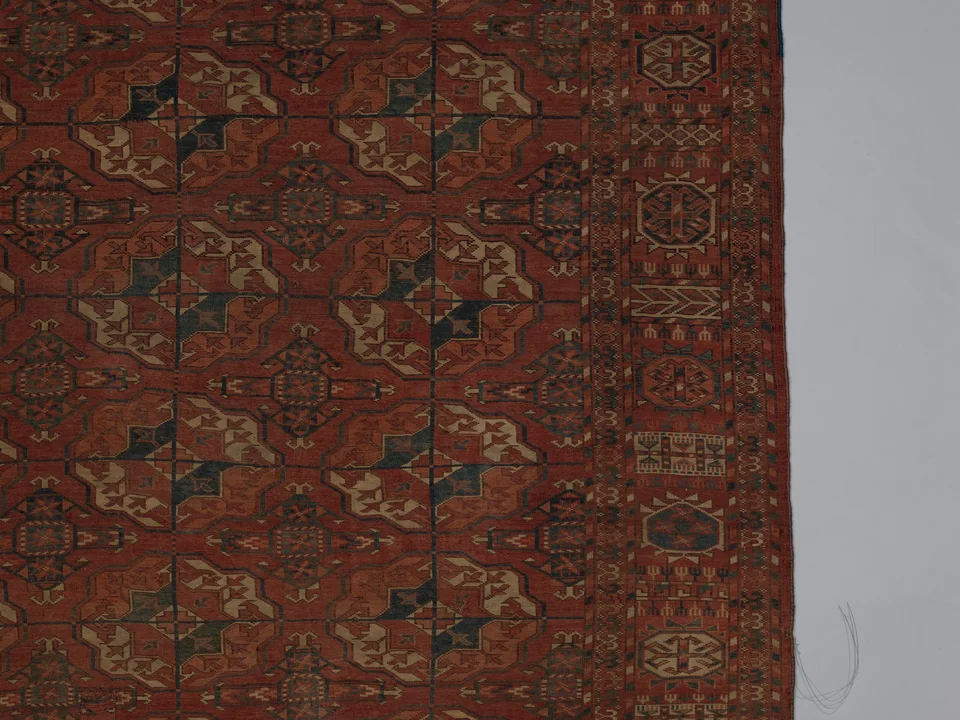
The opening photograph is a documented Tekke main carpet, not a modern commercial Bokhara. It offers a historical point of comparison as we trace the relationship between the two. The photographs are reused from The Met’s Open Access collection.14 If you are new to the subject, our Beginner’s Guide provides a wider introduction before you return to this more focused page.
What is a Bokhara rug?
Imagine a deep red ground, repeating rounded or angular forms and a succession of narrow borders. This is a familiar arrangement in the carpet trade. A rug sold as Bokhara may use such a composition while varying in fiber, size, color, knotting and place of manufacture. The repeated design is an invitation to learn about its sources, not proof of where it was made.
A note on terminology
A name, not necessarily a place.
Separate three ideas: the historical town of Bukhara, a Turkmen weaving tradition, and the commercial Bokhara design name. They can intersect, but one does not automatically establish the others.
Older catalogues may use spellings such as Bokhara, Bukhara or Bhokhara. Retail names such as “Royal Bokhara” should also be read as descriptions unless documentation establishes a specific origin or association. Neither “royal” nor the name of a city is evidence of ownership by royalty.
Where the Bokhara name comes from
Bukhara, in present-day Uzbekistan, is a historic center of exchange and scholarship in Central Asia. UNESCO describes its long significance on the Silk Roads. The city connects the rug’s familiar name to a wider history of trading networks.2 A textile’s market name can survive long after it leaves the place in which it was actually woven.
One compelling example is the Nelson-Atkins Museum of Art’s Tekke Turkmen Rug, dated circa 1880. Its current catalogue lists “Bhokhara Rug” as a former title.7 The change illustrates why records should be consulted rather than relying on a single historical label. It does not mean nothing was woven in Bukhara: a later Powerhouse record offers an example probably made in the city itself.


From Bhokhara to Tekke
Tekke Turkmen Rug · c. 1880 · object 48-25/3. Former title preserved in the museum catalogue.
Explore the museum record ↗For the wider regional setting, see History & Heritage.
The Turkmen roots of the design
Historical Turkmen textiles were made in a range of communities across Central Asia and neighboring lands. Weaving served many purposes: floor coverings, door hangings, bags and bands designed for tent interiors and everyday use. A large main carpet is only one part of this textile world.5
The Tekke tradition is a particularly useful reference when looking at the familiar Bokhara arrangement. Other traditions, including Salor, Yomut, Saryk, Ersari and Chaudor, have their own histories and varied design repertoires. The Met's Salor main carpet record offers an account of how influential Salor compositions may have been.15 Not every Turkmen rug shares the same medallion arrangement: the Powerhouse Beshir carpet, for example, has a different field design.16
These textiles represent the knowledge and decisions of their makers. The practice of Turkmen carpet making is a living heritage, recognized on UNESCO’s Representative List in 2019.12 Discover more in our Tekke rugs, Yomut rugs and Rug Styles guides.
Reading the elephant-foot pattern
The gul (also written göl or gül) is a recurring medallion associated with many Turkmen carpets. A viewer may find a divided interior, stepped edges, hooked outlines or changes of color between quadrants. In rug shops, “elephant foot” is a familiar nickname used for certain rounded or octagonal patterns. It is a useful visual description, not an established explanation of the motif’s original meaning.


Look next at the spaces between the principal forms. Small ornaments can establish a second visual rhythm. Borders turn attention toward the center, while woven ends or patterned end panels may form a distinct part of the composition. A field that looks regular from a distance can contain subtle changes in scale or spacing.
Do not read a single gul as a signature. Motifs traveled among weavers and changed with time. The same pattern can appear in objects with different construction and production histories.1 Explore the visual vocabulary in Patterns & Motifs and the Glossary.
Colors, materials & craftsmanship
Red is common in historical examples, from earthy brick shades to rich crimson and darker wine tones. The shade can depend on the dye, wool, processing, exposure to light and other factors. Madder was an important red dye in regional carpet making, but a reddish hue cannot demonstrate the presence of madder; synthetic dyes can produce related colors.11 Blues, pale areas and dark outlines add contrast. Modern interpretations may also use cream, green or other backgrounds.
In a hand-knotted carpet, rows of pile yarn are secured around the lengthwise warps, while crosswise wefts help establish the foundation. The cut ends form the textured surface.10 The historic Tekke carpet shown above has wool warp, weft and pile and asymmetrical knots, as recorded by The Met.3
Commercial rugs may have cotton or wool foundations and a range of pile materials. A soft handle or high knot count alone is not a ranking of quality. Durability, yarn condition, the consistency of the weave and the intended use deserve attention as well. See Craftsmanship for a deeper look at construction.
From weaving tradition to international style
There is no single documented invention date for Bokhara rugs. A more useful story follows surviving objects, changing names and different centers of production. The historical record also distinguishes a customary design from the circumstances of its later manufacture.
- Historical main carpets
The Met’s Ballard carpet provides a surviving example of Tekke design.3
- Carpets enter collections
Collectors and researchers increasingly document Turkmen weaving; the Nelson-Atkins example is dated c. 1880.7
- Cataloguing & study
Published studies from the early 20th century, including Bogolyubov’s work often dated between 1907 and 1909, help develop the study of regional carpets.1
- Commercial adaptations
Powerhouse records a Soviet-era carpet using a Tekke design, probably woven in Bukhara.6
- Living heritage
UNESCO inscribes traditional Turkmen carpet making in Turkmenistan.12
Pakistan is a well-established producer of commercial Bokhara designs. The Trade Development Authority’s carpet report illustrates a contemporary example (see page 7).8 Afghanistan also has longstanding Turkmen weaving communities and networks of carpet producers and merchants. A rug associated with either country may be a handmade textile of real craftsmanship. It is worth asking where the weaving took place and whether a label describes the design, the maker or the export market.
Historical Turkmen rugs and modern Bokhara rugs
Two records, separated by roughly a century, help demonstrate both continuity and change. Examine the museum images and the terms each institution uses to describe its object.

Commercial Bukhara carpet
Circa 1950; probably Bukhara, Uzbekistan. The museum records machine-spun wool, asymmetrical hand knotting and synthetic colors. It was purchased in 1952.6
View the object and photograph at Powerhouse ↗Record link only; photograph not reproduced.
The Met’s second Tekke carpet uses asymmetrically knotted wool pile.4 The later commercial example is also hand-knotted. Its production setting and yarns differ, but a manufacturing context does not necessarily mean the knots were made by machine.
| Feature | Historical Turkmen examples | Modern Bokhara-style examples |
|---|---|---|
| Origin | Particular weaving communities | Various regions and workshops |
| Pattern | Regional repertoires and variation | Adapted or standardized designs |
| Foundation | Frequently wool | May be cotton or wool |
| Color | Natural and, in later examples, synthetic dyes | Natural or synthetic dyes |
| Construction | Hand-knotted pile in the examples here | Hand-knotted or machine-made |
| Context | Household use, gifts and exchange, or trade | Often made for decorative markets |
These are broad tendencies, not criteria for certifying age, quality or origin. Historical workshop rugs and contemporary community-made rugs complicate any simple division.
Common modern trade names
What labels often mean in the marketplace
Royal Bokhara
Usually a retail style name for a polished repeating-medallion design. It is not evidence of royal patronage.
Pakistani Bokhara
Often refers to later workshop production in Pakistan using Turkmen-derived medallions and borders. The label may describe production, design, or both.
Afghan Bokhara
Can refer to rugs woven in Afghanistan, sometimes by Turkmen communities, sometimes for export markets using a familiar Bokhara-style palette and layout.
Tekke Bokhara
Usually signals a design relationship to Tekke-type medallions rather than a guarantee that the rug is a historical Tekke weaving.
These labels are useful starting descriptions, but they should be checked against structure, materials, date, and any documented provenance.
How to identify a Bokhara rug
Begin by describing what you can see before deciding what the name tells you. A rug with a recognizable design may be straightforward to describe as Bokhara-style; proving that it was woven by a particular group is a separate task.
- Photograph the whole face. Include the borders and both ends. Record the dimensions without stretching the rug.
- Look at the repeat. Note the number, shape and divisions of the main medallions and the forms between them.
- Examine the reverse. Look for the yarns forming the structure and any changes associated with wear or repair.
- Check the ends and edges. Are the visible fringes continuous with the foundation, applied later, or repaired?
- Gather documentation. Keep labels, invoices and family history; distinguish a personal recollection from a documented claim.
- Keep conclusions provisional. Ask a knowledgeable rug specialist about uncertain origin, materials or dating.
Do not rely on destructive fiber or dye tests at home. Good photographs of both sides can support an informed preliminary opinion, but they may not establish authenticity or age. Our A Closer Look guide shows additional views of the same documented carpet.
Buying, collecting & caring for Bokhara rugs
Before buying, decide whether you want a decorative floor covering or a textile of particular historical interest. For daily use, the dimensions, condition, suitability and quality of the materials may be the practical priorities. If collecting, ask for the basis of the attribution, estimated date and any documented provenance.
Prices are not a simple function of age or knots per square inch. Unusual designs, condition, repairs, availability and reliable history can matter. Compare like-for-like examples and seek an independent appraisal before a significant purchase or sale. Explore Buying & Collecting for the buyer’s checklist.
Protect carpets from prolonged direct sunlight, damp conditions and aggressive cleaning. Avoid folding a fragile rug; supported rolled storage is often more appropriate, depending on its structure and condition.13 For unusual stains, weak foundations or antique textiles, ask a qualified textile conservator or rug-cleaning specialist. Read Care & Display before choosing a treatment.
Frequently asked questions
Where do Bokhara rugs come from?
The design family has strong roots in Turkmen weaving. The trade name is associated with Bukhara in Uzbekistan. Contemporary examples are also made in Pakistan, Afghanistan and other countries.1
Are Bokhara rugs and Turkmen rugs the same?
Not necessarily. The names overlap in older carpet terminology, but a Bokhara-style rug may have been made outside a Turkmen community.
What is an elephant-foot rug?
It is a trade nickname for rugs featuring certain rounded or octagonal medallions. It does not establish the motif’s original symbolic meaning or place of weaving.
Are all Bokhara rugs handmade?
No. The pattern can be used in both handmade and machine-made rugs. Ask how the pile and foundation were constructed.
Why are many Bokhara rugs red?
Red is prominent in historical Turkmen designs. Both natural dye sources, such as madder, and synthetic dyes can create red shades. Color alone does not identify a dye.
Are Bokhara rugs valuable?
Value depends on the particular piece: age, condition, quality, rarity, documented history and market demand. The name alone cannot determine its worth.
How can I tell how old my Bokhara rug is?
Construction, materials, wear, repairs and a documented ownership history can help. A photograph or pattern alone is rarely enough for a reliable date.
Is Bokhara the same as Bukhara?
Both spellings refer to the Central Asian city. Bokhara remains familiar in English-language rug trade terminology.
Sources and further reading
Museum dates and geographical attributions follow their collection records. The commercial examples are linked to their records rather than reproduced. Reference links provide further reading, not institutional endorsement. Original SVG illustrations on this page were prepared for TurkmenRugs.com and are not third-party historical photographs.
- Walter B. Denny · Encyclopaedia Iranica. Carpets xvi. Central Asian Carpets ↗↩1↩2↩3↩4
- UNESCO World Heritage Centre. Historic Centre of Bukhara ↗↩1
- The Metropolitan Museum of Art. Tekke Main Carpet, 22.100.45 ↗↩1↩2
- The Metropolitan Museum of Art. Tekke Main Carpet, 2009.458.13 ↗↩1
- The Metropolitan Museum of Art. The Dwelling ↗↩1
- Powerhouse. Turkmen design factory-produced carpet, Bukhara, c. 1950 ↗↩1↩2
- The Nelson-Atkins Museum of Art. Tekke Turkmen Rug, 48-25/3 ↗↩1↩2
- Trade Development Authority of Pakistan. Carpets: product report (PDF) ↗↩1↩2
- Afghanistan Research and Evaluation Unit. Understanding Markets in Afghanistan: A Case Study of Carpets and the Andkhoy Carpet Market ↗↩1
- The George Washington University Museum and The Textile Museum. Textile Terms ↗↩1
- Encyclopaedia Iranica. Carpets ii. Raw Materials and Dyes ↗↩1
- UNESCO Intangible Cultural Heritage. Traditional Turkmen carpet making art in Turkmenistan (inscribed 2019) ↗↩1↩2
- The George Washington University Museum and The Textile Museum. Storing Textiles ↗↩1
- The Metropolitan Museum of Art. Open Access ↗↩1
- The Metropolitan Museum of Art. Salor Main Carpet ↗↩1
- Powerhouse. Turkmen Beshir carpet from Central Asia ↗↩1
Photographs & preparation
Historical photographs are from The Metropolitan Museum of Art: Tekke Main Carpet, 22.100.45, The James F. Ballard Collection, Gift of James F. Ballard, 1922; and Tekke Main Carpet, 2009.458.13, Gift from the Collection of Hillary Black Dumas and Dr. D. Gilbert Dumas, 2009. Their photographs are designated Public Domain. Full images retain the supplied framing; detail crops are identified and the reverse is a separate view. The social graphic uses the complete Ballard photograph with new editorial typography. The Bukhara architecture illustration and route diagram are original TurkmenRugs.com editorial graphics. Full image credits.