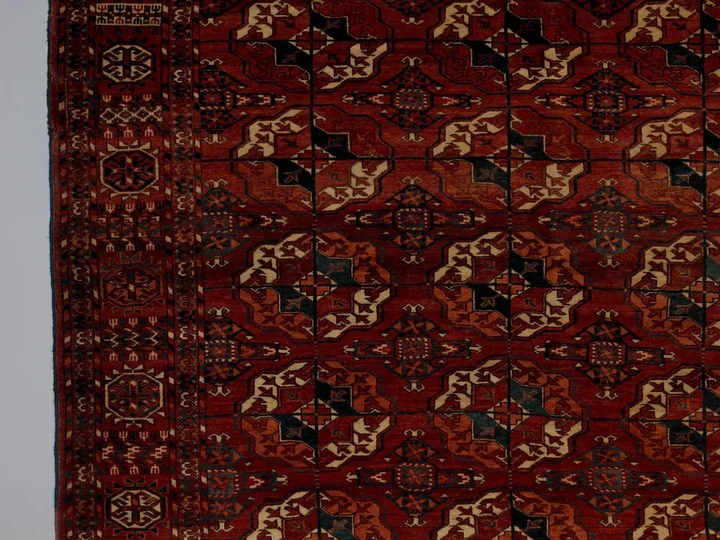
From fiber to finished rug
Look closely at a pile rug and its surface resolves into short lengths of yarn. Beneath them lies a woven foundation. The design and this underlying structure are made together, row by row: the colored pile is secured around lengthwise yarns, with crosswise yarns helping hold it in place.1
This guide concentrates on knotted-pile Turkmen carpets and related furnishings, including the museum examples below. Turkmen textile traditions also include other structures; even a pile carpet may have flatwoven areas at its ends. A description of pile construction therefore does not describe every part of every weaving.
Three words make the process easier to follow. Warp means the lengthwise yarns held under tension on the loom. Weft means yarn that travels across them. Pile is the raised surface formed here by cut yarn ends. Warp and ground weft together make the foundation; pile adds another system of yarn.1
- Warp
- Lengthwise yarns held under tension.
- Weft
- Yarn that crosses the warps.
- Pile
- The raised surface of cut yarn ends.
Our History & Heritage guide explores the people and households behind the textiles. Here, begin with a different question: what is this particular object made from, and how do its parts work together?
Materials: more than a label saying “wool”
Wool has a central place in Turkmen carpet making, but “a wool rug” is a starting point for inquiry. Wool fibers vary in length, fineness, luster, and other properties. Their surface scales help fibers hold together in a spun yarn; resilience and flexibility also contribute to how a finished wool textile behaves.2
Cotton and silk can appear alongside wool. These are different kinds of fiber: wool and silk are animal proteins, while cotton is plant cellulose. Their presence is best described component by component. A carpet with wool pile need not have wool warp and weft, and a museum listing of several fibers may not assign each one to a precise location.3
Three textiles, three material descriptions
The following records describe individual objects in The Metropolitan Museum of Art. Compare what is actually stated rather than turning one object into a rule for a whole tradition.456
| Documented object | Materials in the museum record | Pile construction |
|---|---|---|
| Tekke Main Carpet, 22.100.45; early 19th century | Wool warp, weft, and pile | Asymmetrically knotted |
| Tent Door Hanging (Ensi), 22.100.42; first half 19th century | Wool warp, weft, and pile, with cotton pile | Symmetrically knotted |
| Salor Main Carpet, 1974.149.46; late 18th–early 19th century | Wool warp, weft, and pile, with silk also listed | Asymmetrically knotted |
On small screens, scroll the table to compare all columns.
 View photograph
 View photograph
 View photograph
For the Salor carpet, the record’s short medium line does not specify where the silk occurs. That is a useful boundary to preserve. A detailed technical study might answer a question that a brief online label leaves open.
Color and shine alone are unreliable fiber labels. Wear, lighting, blends, and the small area visible in a photograph can complicate an impression. Conservation identification uses the properties of the fibers themselves, sometimes with microscopy or other examination. For an important purchase or attribution, ask for documentation rather than guessing from appearance.7
Preparing the yarn
The route from fleece to yarn involves choices before weaving begins. UNESCO’s documentation of Turkmen carpet making includes wool sorting, combing, and spinning. Its photographs show preparation as part of the craft, alongside loom work.8
Sorting separates material for its intended use. Cleaning prepares it for further handling; combing or carding opens and arranges fibers in different ways. These words should not be treated as an obligatory sequence performed identically in every household or workshop. The preparation depends on the fiber and the yarn being sought.
Spinning introduces twist to hold fibers together as a continuous yarn. Plying twists two or more yarns together. They describe related but distinct operations: a yarn can be a single spun strand, or several strands combined. Looking at a thread with suitable magnification may reveal those strands and the direction of twist.1
The source of the yarn and the method of constructing the carpet are separate questions. A hand-knotted carpet can use machine-spun yarn. For example, Powerhouse describes its mid-20th-century Turkmen-style carpet, A4376, as hand-knotted with machine-spun wool. That record gives evidence for that object, rather than a date test for another rug.9
When reading a description, useful questions include: which components are being described, how was the yarn prepared, and what evidence supports the answer? A visible irregularity can prompt closer looking, but it cannot supply a complete production history on its own.
Creating color
Color begins with more than the name of a dyestuff. Fiber, preparation, dye concentration, and the dyeing process all affect the result. Some dyes use a mordant, a substance involved in fixing the color to the fiber. Different treatments can produce different shades from the same source; combining or overdyeing colors can extend a palette.10
Madder, indigo, and other plant or insect sources belong to the wider history of textile dyeing. Their names are useful vocabulary, but a red field is not proof of madder. The Textile Museum’s color studies demonstrate how a single source can yield varied results and how natural and synthetic colorants complicate a simple visual judgment.10
Setting up the loom
The loom keeps warp yarns under tension while the weaver works. Separating groups of warps makes an opening, called a shed, through which weft can pass. The foundation grows as the weft interlaces with the warp; in plain weave, a weft goes over one warp and under the next, with the following passage reversing that relationship.12
Turkmen carpet-making documentation includes both horizontal and vertical looms. These terms describe the general orientation of the working arrangement. They should not be used as a shortcut for assigning a rug’s age or quality.13
Read the foundation first
The supporting weave
In the diagram, the upright lines represent warp and the crosswise lines represent ground weft. Upright here describes the drawing; a horizontal loom still has warp. The two directions refer to the textile’s structure rather than the way a photograph is turned.
A small foundation sample is easier to understand than an entire carpet. Follow one yarn before moving to the next. The front of a pile carpet can conceal much of that supporting weave, which is one reason the reverse is so useful to study.
Tension, yarn thickness, and the way the rows are packed all belong to construction. A finished object records their combined result. Avoid diagnosing a whole weaving process from a single uneven edge, especially when a rug’s use and repairs are unknown.
Building the pile, one row at a time
In a knotted-pile carpet, pile yarn wraps around the warps, commonly in pairs. Rows of pile alternate with ground weft, and the work is packed together. Repeating this builds the design. Weft arrangements vary; there is no single row recipe for all Turkmen rugs.14
Although these units are conventionally called knots, it helps to picture wrapped yarn secured within the weave. The textile’s ground structure contributes to holding the pile in place.12
Symmetrical and asymmetrical knots
In a symmetrical knot, both pile ends emerge between the two wrapped warps.16 In an asymmetrical knot, one warp is fully encircled and the yarn passes behind its neighbor. Asymmetrical knots can open to the left or right.14
The drawings show isolated cross-sections, looking along the warp yarns. They spread the wraps apart for clarity and omit the ground weft. They explain a relationship rather than the compact appearance of an actual carpet back.
The object records provide a practical comparison: The Met identifies asymmetrical construction in its Tekke example and symmetrical construction in the ensi. Neither knot name should be treated as a universal definition of Turkmen weaving or a quality ranking.45
Two paths around two warps
Symmetrical
Both ends emerge between the warps.
Asymmetrical
One warp encircled; open to the right as drawn.
- Warp yarns, seen end-on
- Pile yarn
What knot density tells you
Knot density describes how many pile units occupy an area. A finer structural grid can accommodate small details, but the count does not describe the whole achievement of a textile. The Met’s examination of the Emperor’s Carpet considers its close construction alongside its materials, dyes, and condition.11
When comparing figures, check the unit used and whether the count was measured or estimated. Then return to the rug: does the design read clearly, how does the surface survive, and what do the condition records say? A number is most useful when it answers a specific question.
Finishing the surface, sides, and ends
Cut pile is trimmed to produce the working surface.14 A complete view and a close photograph answer different questions: one shows the overall design, while the other reveals the surface that carries it. Compare them before making a judgment about either.
At the long sides, inspect how the edge is constructed and protected. A selvedge is a woven edge where weft turns back into the textile; carpet sides can involve additional finishing arrangements. Record the feature you see rather than use “selvedge” as a general name for every later binding.1
At the short ends, look for flatwoven areas, remaining warp ends, and any finishing or securing work. Fringe often continues the foundation’s warps, but a fringe visible today may include later additions. A photograph does not establish which parts are original.
The end-detail photograph below belongs to the same Tekke carpet shown at the top of this page. Compare the pile field, the lower woven area, and the loose ends. The change in structure is visible without needing to identify every repair or intervention.
Condition and treatment history matter when interpreting such details. Missing end fabric, altered side finishes, or replacement fringe can change what survives for study. If you own a fragile rug, use the Care & Display guide for handling guidance and ask a textile conservator about uncertain areas.
 View photograph
Looking at craftsmanship for yourself
Begin with the whole object, then move closer. Use the same order each time so that a striking pattern or unusually fine detail does not distract from the rest of the textile.
 View photograph
- Front: Take in the proportions, pattern, palette, and relationship between field and borders. Then look at the pile surface and any visible changes in height or wear.
- Reverse: Follow the structure behind the design. Notice how clearly the yarn systems can be distinguished and where a closer photograph would help. Avoid forcing an uncertain knot identification.
- Long sides: Compare both edges. Note differences, loose areas, and changes of material without assuming when they occurred.
- Short ends: Look for the transition from pile to flatweave and fringe. Ask whether a condition report distinguishes original finishing from later work.
- Record: Separate the object’s documented date, materials, and attribution from your own observations. Keep the accession number or seller’s reference with your notes.
Observation, documentation, and analysis
“I can see a change in the red” is an observation. “The museum lists cotton pile” is a statement from a record. “Analysis identified a particular dye” is a technical finding. Keeping these kinds of evidence distinct makes a description more useful and easier to revise.
Craftsmanship is best appreciated through that combination of looking and learning. For the visual language, continue to Patterns & Motifs. For comparisons between weaving traditions, use Rug Styles. If you are considering a purchase, our Buying & Collecting guide turns these questions into a practical inspection.
Frequently asked questions
Are Turkmen rugs always entirely wool?
No. The Met’s Tekke example lists wool throughout, while its ensi includes cotton pile and its Salor carpet also lists silk. Read the material description for each component and object.456
What is the difference between warp, weft, and pile?
Warp runs lengthwise; weft travels across it. In the knotted-pile carpets discussed here, additional yarn wrapped around the warps forms the raised cut surface. The diagram separates these systems so their roles are easier to see.12
What is the difference between symmetrical and asymmetrical knots?
Their yarn takes a different path around the warp pair. In the symmetrical arrangement both pile ends emerge between the warps. An asymmetrical arrangement fully encircles one warp and passes behind the other; it can open left or right.14
Can I identify natural dyes from a photograph?
A photograph can record color, but it cannot establish the dye chemistry. Reliable identification may need specialist examination and analysis. A convincing-looking red or an uneven shade is not a substitute for that evidence.11
Does a higher knot count automatically mean a better rug?
No single count settles that judgment. Density is one construction measurement. Consider how well the structure serves the design, alongside materials, condition, finishing, and the evidence behind the description.
How long does it take to make a Turkmen rug?
There is no useful universal answer. Size, construction, design, yarn preparation, the number of people working, and their working schedule all affect a production estimate. For a particular new rug, ask its makers what stages and labor their estimate includes.
Sources and further reading
Museum object records support the examples on this page; textile and conservation references explain terminology and methods. Attributions and technical descriptions may be refined as collections are studied. The diagrams are original explanatory schematics, not photographs or weaving instructions.
-
The George Washington University Museum and The Textile Museum, Textile Terms. Definitions of warp, weft, pile, spinning, plying, and selvedge.
↩1↩2↩3↩4 -
The George Washington University Museum and The Textile Museum, Fiber. Fiber properties and their effects on textile making.
↩ -
Canadian Conservation Institute, Natural Fibres, CCI Notes 13/11. Protein and cellulosic fibers.
↩ -
The Metropolitan Museum of Art, Tekke Main Carpet, 22.100.45. Early 19th century; attributed to Turkmenistan; wool warp, weft, and pile; asymmetrically knotted.
↩1↩2↩3 -
The Metropolitan Museum of Art, Tent Door Hanging (Ensi), 22.100.42. First half 19th century; attributed to present-day Afghanistan or Turkmenistan; wool and cotton pile; symmetrically knotted.
↩1↩2↩3 -
The Metropolitan Museum of Art, Salor Main Carpet, 1974.149.46. Late 18th–early 19th century; attributed to southern Turkmenistan; wool and silk; asymmetrically knotted.
↩1↩2 -
Canadian Conservation Institute, Identification of Natural Fibres, CCI Notes 13/18. Limits and methods of fiber identification.
↩ -
UNESCO, Turkmen carpet-making documentation: photograph captions. Includes wool sorting, combing, spinning, and loom work. Photographs are not reproduced here.
↩ -
Powerhouse Collection, Carpet, A4376. Mid-20th-century example described as hand-knotted with machine-spun wool and synthetic colors; acquired in 1952.
↩1↩2 -
The George Washington University Museum and The Textile Museum, Color. Dye sources, mordants, and variation in color.
↩1↩2 -
The Metropolitan Museum of Art, Making the Invisible Visible: Conserving the Emperor’s Carpet. Examination and dye analysis of an Iranian Safavid carpet; a methodological comparison, not a Turkmen example.
↩1↩2↩3 -
The George Washington University Museum and The Textile Museum, Structure. Interlacing, plain weave, and knotted pile.
↩1↩2↩3 -
UNESCO, Traditional Turkmen carpet making art in Turkmenistan. Representative List inscription, 2019; documentation of horizontal and vertical looms.
↩ -
The Metropolitan Museum of Art Bulletin, Islamic Carpets: The Joseph V. McMullan Collection, June 1970. Technical construction discussion and symmetrical/asymmetrical knot figures. Used for structure terminology, not generalized cultural or origin claims.
↩1↩2↩3↩4 -
Getty Research Institute, Art & Architecture Thesaurus, Abrash (textile dye condition), 300193857. Definition of shade variation associated with dyeing and dye lots.
↩ -
Getty Research Institute, Art & Architecture Thesaurus, Symmetrical knots, 300186806. Definition of the two-warp arrangement and pile ends.
↩
Photographs & diagrams
The photographs show three documented textiles at The Metropolitan Museum of Art. The Tekke carpet appears in complete, front-detail, reverse-detail, and end-detail views; the ensi and Salor carpet appear in complete views. The museum marks these photographs Public Domain. Colors and designs have not been altered.
The foundation and knot diagrams are original, simplified SVG schematics informed by the technical references above. See Sources & credits for object details and image credits.