Start with the rug you want to live with
Begin with a place and a purpose. Are you looking for a floor covering, a textile to display, or an example of weaving that you want to examine closely? Picture how you will use it before comparing individual listings.
Measure the available space and note the furniture, foot traffic, and light. A rug’s dimensions and condition help determine its appropriate use; conservation guidance draws attention to the effects of wear, furniture, and light exposure.1 Ask whether the particular piece suits the setting you have in mind.
Choose a format, then a textile
Turkmen weaving includes complete carpets, bags, door furnishings, and other forms. Surviving pieces may preserve only part of an original object.2 A rectangular pile textile in a listing might be a bag face rather than a small floor rug. Read the description of its format and what remains.
The Met’s Storage Bag (Chuval) Face, 22.100.40a, offers a useful example: it once formed the front of a deep storage bag.3 Understanding that original purpose changes the questions you ask about its size, surviving edges, and possible display.
 View photograph
Give contemporary weaving room in your search as well. UNESCO describes Turkmen carpet making as a living practice transmitted within families and communities.4 Consider the maker, workmanship, and information available about a new textile alongside your interest in older examples.
Set a total spending limit before shopping. Allow for delivery, any appropriate assessment or care, and a suitable display or floor arrangement. A clear brief makes it easier to recognize a piece that fits your life.
Read the description carefully
A useful listing tells you what the seller knows and how confidently they know it. Separate its claims about construction, materials, place, date, and weaving tradition. Each deserves its own question.
Names, designs, and attributions
You may encounter Turkmen, Turkmen-style, Bukhara, and Bokhara in descriptions. Denny distinguishes Turkmen textiles from commercial Bukhara carpets woven elsewhere using related designs. He also explains that design exchange makes materials, structure, and coloring important to attribution.2
Ask what a label means for the actual piece. Does it describe the pattern, a proposed weaving-group attribution, or a documented place of manufacture? Compare the object and its supporting record, keeping any qualification attached to the claim.
Our Bokhara rugs guide explores the history of this trade name and how to evaluate a rug described by it.
Construction and materials
In a knotted-pile carpet, lengthwise warps and crosswise wefts form a foundation; additional yarn is tied around warps and cut to form the pile.5 Ask whether the seller identifies hand-knotted pile, another handwoven construction, or machine production.
“Handmade” leaves details to clarify. Ask what is recorded for the pile and foundation, and how the fibers were identified. If a natural-dye claim matters to the purchase, request its basis. A color description is a useful observation; an explanation of the material needs supporting evidence.
Dates and degrees of certainty
Sotheby’s carpet glossary describes dating as necessarily inexact and often a matter of opinion.6 Read words such as circa, probably, and attributed to carefully. Ask how an age estimate was reached, and what the seller means by antique or vintage.
For more background, visit our Rug Styles & Weaving Traditions guide and Patterns & Motifs guide.
Check condition from the whole textile to the details
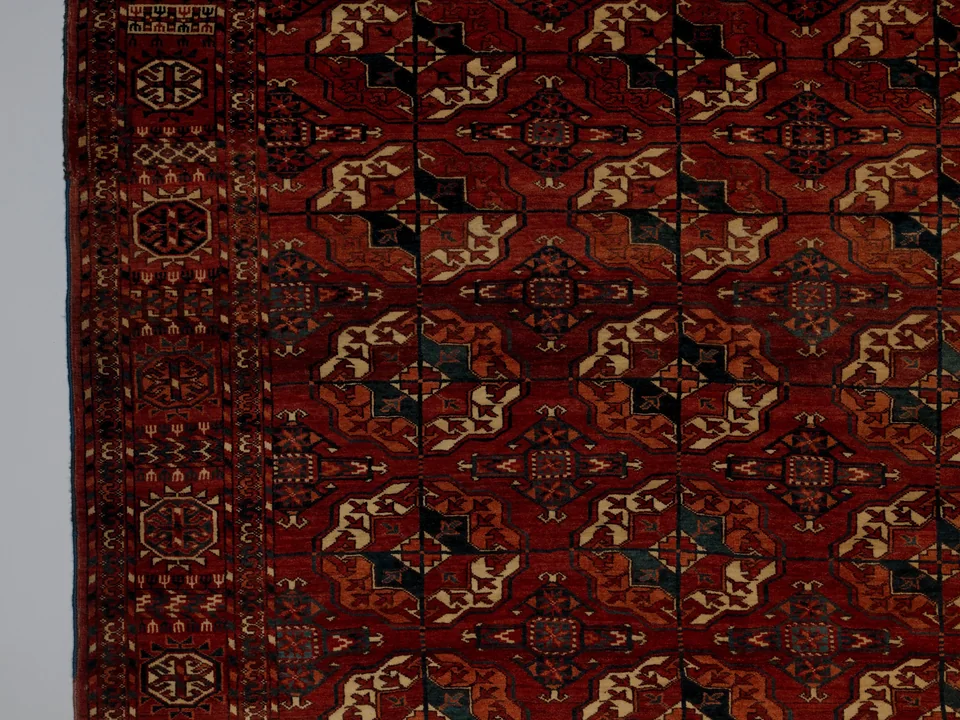
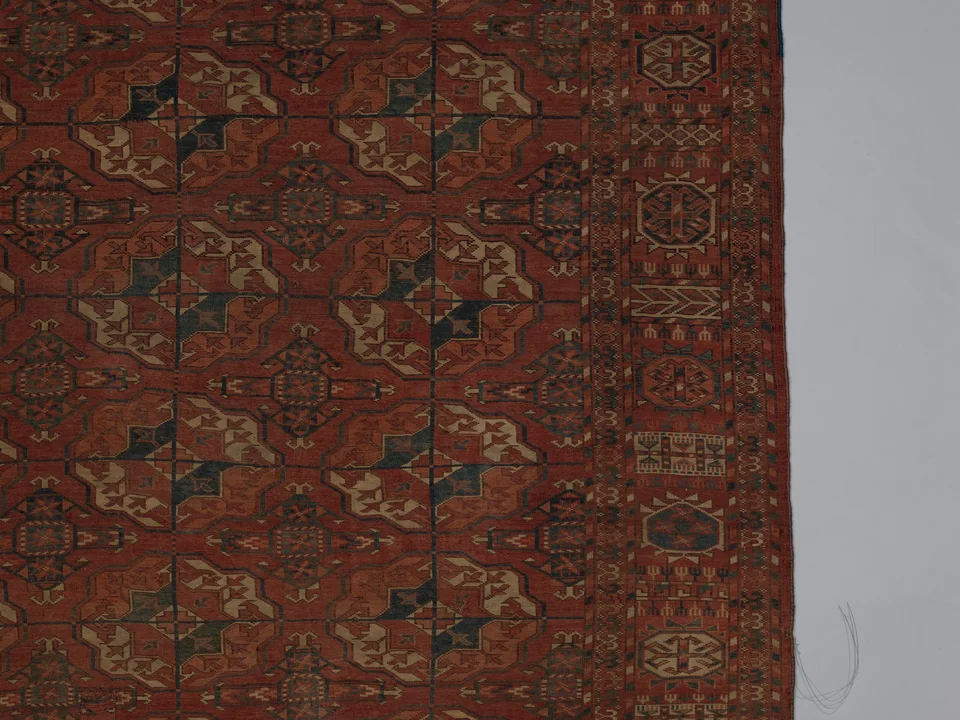
Look first at the complete textile, then move around it systematically. Request views of the face, reverse, long sides, both ends, and corners. Return to the whole view to locate every detail you are discussing.
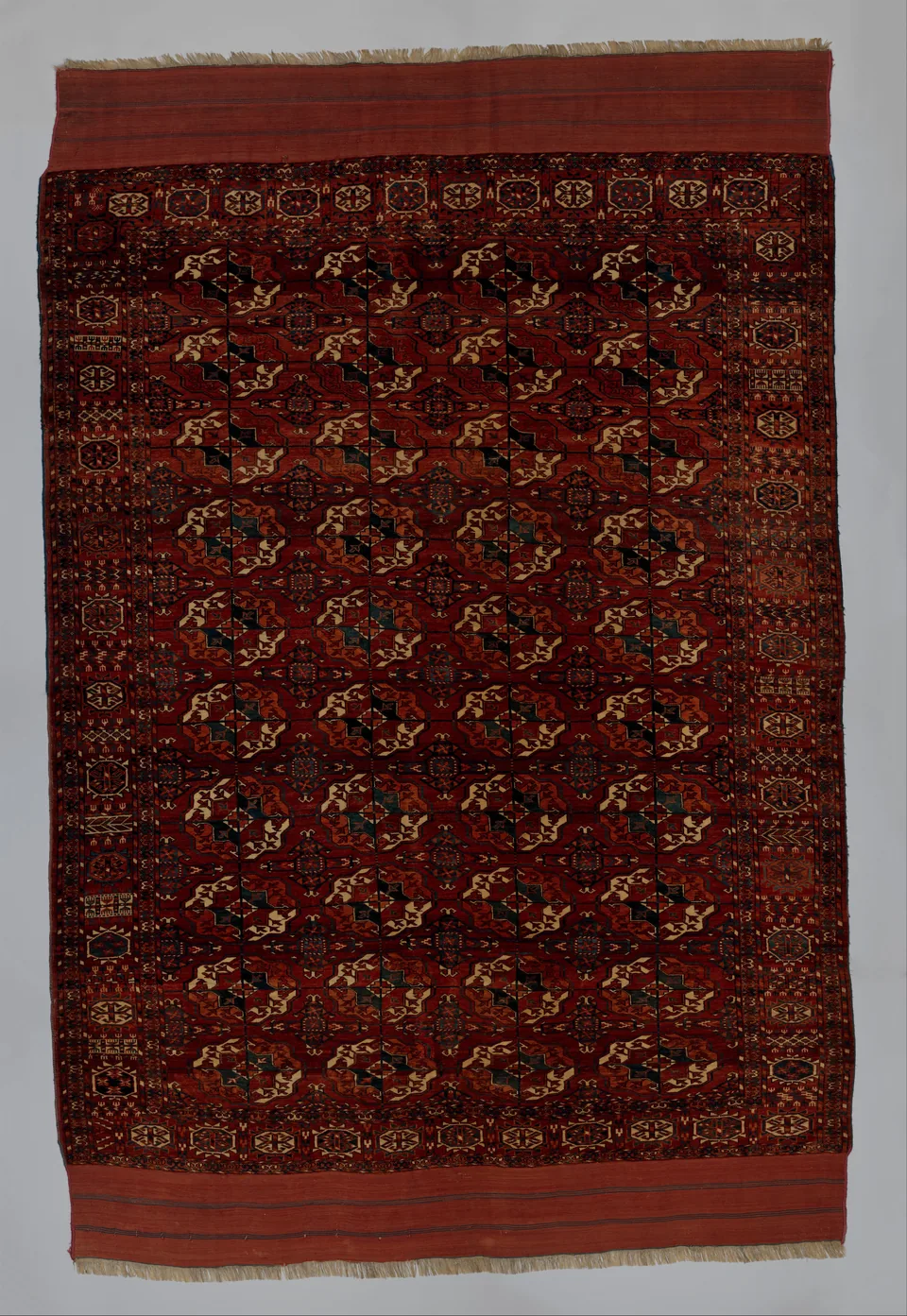
The photographs of The Met’s Tekke Main Carpet, 22.100.45, provide a complete view and closer studies of one documented object.15 Use them to practice locating a detail within a larger textile.
Describe what you see
Ask about worn pile, visible foundation, splits, missing areas, stains, and changes in color. Record the location and extent of an issue. A small area near an end and widespread weakness through the field raise different questions about future use.
Conservation guidance describes insect damage that can include holes and patchy losses of wool pile.7 If you notice a suspicious area, ask for a closer view and an explanation of its condition. Seek appropriate assessment of suspected pest activity before bringing a textile into a collection.
Ask what has been repaired or altered
Ask about reweaving, replaced finishes, patches, altered dimensions, and known color treatments. Christie’s collecting guidance discusses the significance of restoration, reduction in size, and other alterations when assessing carpets.8
Request a description of the work and photographs showing where it is. Useful questions include when it was done, whether a treatment record survives, and whether further work is recommended. Consider the quality and purpose of a repair alongside the age, rarity, and intended use of the textile.
Match condition to your plans
Photographs help you locate visible features. Questions about strength, stiffness, or the stability of a repair may need physical examination. Ask a qualified textile conservator or experienced independent specialist when those questions would change your decision.
Handle a viewed textile with the owner’s guidance. Avoid bending an old foundation to test it, pulling at threads, or trying a dye test. Describe the uncertainty and obtain suitable advice before committing to treatment or an unsuitable use.
 View photograph
 View photograph
Understand what influences the price
Assess the textile as a whole: its drawing, materials, workmanship, condition, documentation, and interest within a field of collecting. Different combinations of these qualities can appeal to different buyers.
Put knot density in context
Knot density describes an aspect of construction. Sotheby’s discussion of collecting explains that comparatively coarse village and tribal weavings can be valued for their materials, design, spacing, and condition.9 Consider fineness alongside what the maker achieved with it.
Look for a composition you enjoy, and compare how its larger and smaller forms work together. Ask which qualities attract you before letting an impressive technical number determine the purchase.
Compare comparable objects
Build a small group of relevant comparisons. Match format, dimensions, proposed period, attribution, and disclosed condition as closely as possible. Keep notes about important differences so that a superficially similar pattern does not carry the entire comparison.
Record whether a figure is an asking price, an auction estimate, or a completed sale. Check the date, currency, and included fees. A single advertised figure gives you limited information about what another buyer would pay for your piece.
Work out the complete cost
At auction, the hammer price is the winning bid; a buyer’s premium is an additional charge.10 Other applicable charges can affect the final amount. Consult the current terms for the particular sale and request a delivery quotation before setting your limit.11
For any purchase, establish which costs apply. Put the price, fees, taxes, delivery, and planned care into the same budget. Choose a textile whose cost makes sense for its documented qualities and the enjoyment you expect from it.
Ask useful questions and request photographs
A short, specific inquiry is easier to answer than a general request for reassurance. Describe your intended use, then ask about the information still missing from the offer.
- What are the exact dimensions, and do they include fringe?
- What construction and materials are being described, and on what basis?
- Is the proposed date or origin documented, estimated, or unknown?
- What repairs, losses, replacements, or alterations are present?
- Is any cleaning, restoration, or color treatment known?
- What invoices, earlier descriptions, or ownership records accompany the textile?
- Is there a condition issue relevant to my intended use?
Request a useful set of views
Ask for a complete front, a complete reverse, the sides and ends, and close-ups of disclosed issues. Request consistent lighting, a useful indication of scale, and enough context to locate each detail on the whole textile.
 View photograph
If color is central to your choice, ask how faithfully the photographs represent it. An opportunity to view the piece or a clear written return arrangement can be valuable when appearance will determine whether it suits your room.
A message you can adapt
Keep the answers with the listing. If a response introduces a new uncertainty, follow up on that particular point before deciding.
Choose a seller and understand the purchase
Ask who supplies the description, who can answer detailed questions, and who will handle a problem. Evaluate the information and written terms for the particular offer.
Dealers, auctions, and marketplaces
An opportunity to discuss a textile directly can be useful. At an auction, request the available condition information and inspect the lot when possible. Sotheby’s buyer guidance explains that catalogue references to condition do not amount to a complete description, and that an omitted defect is not assurance of its absence.11
Confirm the practical terms
Check the return window, the process for notifying the seller, return shipping, and any restocking charge. Confirm the delivery arrangement and keep the transaction records. These are among the checks recommended in the FTC’s online-shopping guidance.12
Use a payment method whose protections you understand. The FTC’s U.S. guidance recommends credit cards when possible; investigate the arrangements applicable to your transaction and country.12
For an international purchase, establish the shipping responsibilities and check current destination requirements with appropriate official sources. Resolve those details while you can still make an informed choice about the complete purchase.
Use a checklist before you pay
Pause long enough to review the offer as a whole. Use this checklist to bring together the questions you have already asked.
If an attribution, significant condition issue, or proposed restoration would materially affect the purchase, seek an independent opinion. There is time to appreciate a textile while deciding whether the information supports buying it.
Build a collection through looking and record keeping
Choose an interest you can return to: a weaving tradition, a textile format, or a particular aspect of design. Compare individual works and record the differences you notice. Our Beginner’s Guide offers a starting point for their materials, construction, and household context.
Keep a record of each acquisition
ICOM’s documentation guidance emphasizes photographs, measurements, materials, distinguishing features, and a short description.13 Adapt that approach to your collection. Add the seller, purchase date, invoice, condition notes, and any later treatment records.
Keep ownership history separate from a proposed place or community of manufacture. Getty describes provenance as the history of an artwork’s ownership.14 Preserve the source of a claim and its degree of certainty, including gaps in what is known.
When the textile arrives
Compare it with the supplied photographs and description, and make your own dated record. Raise any discrepancy promptly through the applicable purchase process. Before treatment or display, obtain advice suited to the piece and its condition; see our Care & Display introduction for the questions to begin with.
Over time, the objects and their records will give you more to compare. Keep looking at the decisions made by the weavers, and let that attention guide the next addition.
Frequently asked questions
Do I need to buy an antique rug to begin collecting?
You can begin with contemporary or older weaving. Choose an example that interests you and that you can describe and care for. Learn what is known about its maker, materials, construction, and history, and keep that information with it.
Does “Bokhara” mean a rug was made by Turkmen weavers?
The name needs clarification. Carpet literature distinguishes Turkmen textiles from commercial Bukhara designs produced elsewhere.2 Ask what the seller intends the term to describe, and request the basis for any specific manufacture or weaving-group attribution.
Does a higher knot count always mean a better rug?
Knot density should be considered alongside design, materials, condition, and the qualities sought within a particular weaving tradition.9 Compare complete textiles and their workmanship before treating a technical figure as a measure of desirability.
Should I avoid every rug that has a repair?
Ask what was repaired, how extensively, and with what result. Consider the work’s stability, appearance, history, and suitability for your intended use. Obtain independent assessment when the answer could materially affect the purchase or require further treatment.
Can photographs establish a rug’s age and origin?
They support comparison and discussion, particularly when accompanied by detailed records. Clarify the evidence behind a proposed date or attribution and preserve any qualification. Where an important uncertainty remains, physical examination and specialist assessment may be needed.
Sources and further reading
This guide brings together scholarly carpet studies, museum records, conservation guidance, and practical buying information. Auction-house references describe their own cataloguing and purchase practices. Consult the current terms for an individual transaction.
The photographs are documented museum study examples. Their captions identify the objects and collections; they are not offered for sale on this site.
-
Canadian Conservation Institute, Basic Care — Carpets and Rugs. ↩
-
Walter B. Denny, “Carpets xvi. Central Asian Carpets,” Encyclopaedia Iranica. ↩↩↩
-
The Metropolitan Museum of Art, Storage Bag (Chuval) Face, 22.100.40a. Early nineteenth century; The James F. Ballard Collection, Gift of James F. Ballard, 1922. ↩
-
UNESCO, Traditional Turkmen Carpet Making Art in Turkmenistan. Inscribed on the Representative List in 2019. ↩
-
Annette Ittig, “Carpets iii. Knotted-pile Carpets: Techniques and Structures,” Encyclopaedia Iranica. ↩
-
Sotheby’s, Guide for Buyers | Glossary & Important Notices, Carpets section. ↩
-
Renée Dancause, Janet Wagner, and Jan Vuori, Canadian Conservation Institute, Caring for Textiles and Costumes. ↩
-
Christie’s, Collecting Guide: Oriental Rugs and Carpets, March 3, 2020, restoration and alteration discussion. ↩
-
Sotheby’s, From Rugs to Riches: What Makes Rugs and Carpets Collectable?, April 18, 2018. ↩↩
-
Sotheby’s, What Is a Buyer’s Premium?. Check current terms for rates and applicable charges. ↩
-
Sotheby’s, Guide for Buyers | Global, especially condition information and purchase charges. ↩↩
-
Federal Trade Commission, Online Shopping. U.S. consumer guidance. ↩↩
-
International Council of Museums, Object ID. Documentation principles informing the original collection-record example in this guide. ↩
-
Amanda Berman, Getty, What Is Provenance?, April 8, 2022; updated October 6, 2022. ↩
-
The Metropolitan Museum of Art, Tekke Main Carpet, 22.100.45. Early nineteenth century; The James F. Ballard Collection, Gift of James F. Ballard, 1922. Source of the complete carpet and detail photographs used as study examples. ↩